via BBC World, Times of Israel, Al Jazeera, +2 more
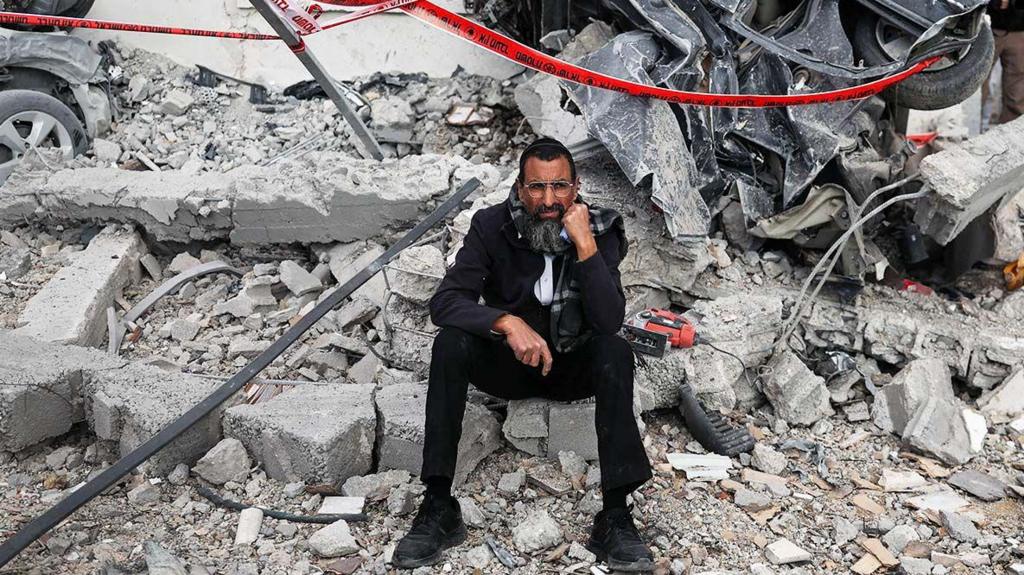
Iran launched six waves of ballistic missiles and drones at Israeli cities and US military installations across the Middle East on Sunday, in retaliation for Operation Epic Fury. The deadliest strike hit Beit Shemesh, west of Jerusalem, where a missile destroyed a synagogue and scored a direct hit on a public bomb shelter, killing nine people and wounding over 40 — including a 4-year-old child. Most of the dead had been sheltering inside the bomb shelter itself. The Revolutionary Guard Corps also struck targets in the UAE, Qatar, Kuwait, Bahrain, Jordan, Saudi Arabia, and Oman, the broadest Iranian military response in the conflict so far. A missile hit Dubai's Fairmont The Palm hotel, setting the building ablaze and injuring four; drone debris struck the Burj Al Arab. The IRGC announced the closure of the Strait of Hormuz to all shipping, threatening the passage through which roughly 20% of the world's oil supply flows. Gulf states temporarily closed their airspace and condemned the attacks. Israel said it launched another round of strikes on Iran in response.
Operation Epic Fury, launched by the US and Israel on February 28, killed Supreme Leader Ayatollah Ali Khamenei, Iran's defense minister, and the Revolutionary Guard commander in strikes on Tehran and military installations across Iran. The Strait of Hormuz is a narrow waterway between Iran and Oman. Its closure, if sustained, would disrupt global oil markets — oil prices surged on the announcement.
An airstrike hit the Shajareh Tayyebeh Elementary School in Minab, southern Iran, during Saturday's US-Israeli offensive, killing at least 148 people according to the local prosecutor. The victims were predominantly girls aged 7 to 12. CNN geolocated video from the scene and found the school sits roughly 200 feet from an Iranian military base, though satellite imagery confirms the two have been separate structures since at least 2016. Responsibility is fiercely disputed: Iran blames the US and Israel, while CENTCOM says it is "aware of reports concerning civilian harm" and is "looking into them," adding it has "never and will never target civilians." The Israeli military says it is "not aware" of operations in the area. Iran's foreign minister said the school was "bombed in broad daylight, when packed with young pupils." Independent verification of the casualty figures has not been possible, but the incident has become the conflict's most politically explosive single event, drawing global condemnation and intensifying calls for a ceasefire.
Minab is a city of about 80,000 in Hormozgan province, near the Strait of Hormuz in southern Iran. Civilian casualty incidents in conflict zones are often contested by all sides. The school's proximity to a military base raises questions about targeting decisions and the proportionality standards required under international humanitarian law, which prohibits attacks where expected civilian harm is excessive relative to the anticipated military advantage.
CENTCOM confirmed Sunday that three American servicemembers were killed and five seriously wounded during Operation Epic Fury — the first US combat deaths of the conflict. Several additional troops sustained minor shrapnel injuries. The Pentagon withheld names, branch, and location pending notification of families. Trump said he took "every possible step to minimize risk" while acknowledging casualties "often happens in war." The deaths sharpened the political fight over war authorization. Bipartisan groups in both chambers are pushing War Powers Resolutions: Tim Kaine and Rand Paul in the Senate, Ro Khanna and Thomas Massie in the House. Even if passed, neither resolution would survive a presidential veto. But not all opposition is Democratic — Senator Lisa Murkowski questioned whether the strikes achieved their objectives, while bipartisan hawks pushed back, citing Iran's nuclear capabilities. The White House was briefed congressional leaders beforehand but obtained no formal authorization.
The War Powers Resolution of 1973, passed after Vietnam, requires the president to notify Congress within 48 hours of deploying forces and limits engagements to 60 days without authorization. No president has ever been meaningfully constrained by it. Trump campaigned in 2024 on a non-interventionist platform and explicitly criticized regime change policies.
A striking convergence: libertarian law professor Ilya Somin at George Mason and Harvard's Jack Goldsmith, a former Bush administration lawyer, both published scathing analyses of the Iran strikes on the same day, arriving at overlapping but distinct conclusions. Somin's argument is straightforward — Article I gives Congress the exclusive power to declare war, Trump himself called this a war, and the scale (regime change, navy destruction, missile industry demolition) makes the constitutional violation "blatant." Goldsmith's analysis is darker: he argues the legal debate itself is theater. No effective constraints — constitutional text, the War Powers Resolution, or Office of Legal Counsel opinions — have ever stopped a president from deploying force. The OLC's own standard for requiring congressional approval has never been invoked to deny presidential authority. The real limit on presidential war, Goldsmith writes, has always been political backlash, not law. Congress bears responsibility by funding massive military capacity without conditions.
Somin, a Cato Institute scholar, also criticized Obama's 2011 Libya campaign as unconstitutional — this is a consistent libertarian position. Goldsmith served as head of the Office of Legal Counsel under George W. Bush and became a leading critic of executive overreach. Their agreement across ideological lines underscores how far outside historical norms the Iran strikes fall.
A gunman opened fire on the patio of Buford's bar on Austin's Sixth Street entertainment district at approximately 2 a.m. Sunday, killing two people and injuring 14 before being shot dead by police officers who returned fire within 57 seconds. The suspect, a naturalized US citizen from Senegal who had lived in the country for 15 years, circled the block multiple times in an SUV before rolling down his window and shooting at patrons, then exited the vehicle with a rifle and fired on pedestrians. The FBI's Joint Terrorism Task Force is leading the investigation, citing "indicators on the subject and in his vehicle" suggesting a potential nexus to terrorism, though mental health issues are also being examined. Three of the injured remain in critical condition. Paramedics pre-positioned in the entertainment district had all patients off-scene within 47 minutes.
Austin's Sixth Street is the city's main nightlife corridor, packed with bars and live music venues drawing thousands on weekend nights. The area has been the site of previous mass shootings, including a 2021 incident that injured 14 people. The FBI's Joint Terrorism Task Force takes over investigations when evidence suggests a political, ideological, or religious motivation.
A study published in Science by researchers at the University of Pennsylvania reveals that interbreeding between Neanderthals and modern humans was strongly sex-biased: it was predominantly Neanderthal males mating with human females, not the reverse. The evidence comes from a clever X chromosome analysis. Modern humans carry almost no Neanderthal DNA on their X chromosomes, yet Neanderthal genomes carry about 62% more human DNA on their X chromosomes compared to other chromosomes. Because X chromosomes are inherited differently depending on the sex of each parent, this asymmetric pattern is a genetic fingerprint of directional mating. The finding challenges the prevailing explanation that natural selection alone created the "Neanderthal deserts" in our genome, suggesting social dynamics and mate choice were powerful evolutionary forces. Lead author Alexander Platt noted he has "no idea whose preference is being expressed here" — whether Neanderthal women were excluded by their own communities or human groups preferentially formed bonds with Neanderthal men remains unknown.
Modern non-African humans carry roughly 1-4% Neanderthal DNA, inherited from interbreeding events approximately 50,000-60,000 years ago in Eurasia. The DNA is unevenly distributed across our genome — notably sparse on the X chromosome and near genes for brain development and fertility, forming so-called "Neanderthal deserts." Whether those gaps arose from natural selection or biased mating had been debated for years.
Six freshly created Polymarket accounts, all opened in February 2026 with no prior trading history, collectively made over $1.2 million betting the US would strike Iran before the end of February — the exact day the strikes occurred. The largest single wallet turned roughly $61,000 into over $493,000. Most wallets were funded within 24 hours of the attack. Total trading volume on Iran-related contracts hit $529 million, Polymarket's largest geopolitics market ever. Polymarket defended itself by calling prediction markets "invaluable" for providing information "in ways TV news and X could not." Rep. Mike Levin demanded answers, saying prediction markets "cannot be a vehicle for profiting off advance knowledge of military action." Critics also noted that Donald Trump Jr. sits on Polymarket's advisory board, raising conflict-of-interest questions given the administration launched the strikes.
Polymarket is a cryptocurrency prediction market that lets users buy and sell shares in the outcome of real-world events. It gained mainstream attention during the 2024 US election. The platform operates on public blockchains with pseudonymous accounts, making insider trading difficult to regulate. Previous controversies include markets on the Palisades wildfires and assassination outcomes.
Internal Meta documents obtained by the New York Times reveal plans to add real-time facial recognition to its Ray-Ban smart glasses under the codename "Name Tag." The feature would let wearers identify strangers on sight, pulling up names and profile information through Meta's AI assistant. A May 2025 internal document states Meta planned to "launch during a dynamic political environment where many civil society groups that we would expect to attack us would have their resources focused on other concerns" — an explicit strategy to deploy surveillance technology while advocacy groups are distracted. The Electronic Frontier Foundation called the approach "craven and morally bankrupt." The Electronic Privacy Information Center has urged the FTC to investigate, warning the feature creates risks of "stalking, harassment, doxxing and worse." Two Harvard students previously demonstrated the real-world threat by building I-XRAY, a tool that combined Meta glasses with facial recognition to identify strangers in public.
Meta's Ray-Ban smart glasses already have front-facing cameras for photos and video. Adding facial recognition transforms them from a recording device into an identification device. Meta shut down Facebook's facial recognition system in 2021, citing privacy concerns — it is now putting equivalent technology literally on people's faces. Over 7 million pairs of the glasses have been sold.
Five DHS agents entered a Columbia University residential building at 6:30 a.m. on February 26 by telling staff they were police searching for a missing child, flashing a photo captured on security cameras. A university public safety officer asked multiple times for a warrant and requested time to call a supervisor; both were refused. The agents detained Elmina "Ellie" Aghayeva, a senior from Azerbaijan studying neuroscience and political science. ICE claimed her student visa had been terminated in 2016 "for failing to attend classes" — a claim hard to reconcile with her current enrollment as a Columbia senior. Columbia's president condemned the agents for making "misrepresentations to gain entry" without a warrant. Aghayeva was released approximately nine hours later after New York Mayor Zohran Mamdani said Trump personally called him to arrange the release. She posted on social media that she was "safe and okay" but "in complete shock."
ICE enforcement on college campuses has escalated since the Trump administration designated universities as locations where enforcement could occur. Previous administrations generally treated schools as sensitive locations where immigration enforcement was off-limits. The use of false pretenses to gain entry without a judicial warrant raises Fourth Amendment concerns about unreasonable searches.
Andrew C. McCarthy, former federal prosecutor and conservative legal commentator, argues in National Review that the Trump administration's designation of Anthropic as a "supply chain risk" constitutes a modern bill of attainder — a government act punishing a specific entity without trial, explicitly prohibited by the Constitution. After Anthropic refused Pentagon demands to remove safety guardrails preventing use in autonomous weapons and mass surveillance, the administration banned all federal agencies from using the company's technology. OpenAI struck a Pentagon deal within hours. McCarthy frames this as "thuggish behavior masquerading as national security" and warns it sets a precedent where any company that resists government demands can be destroyed by executive fiat. The piece is notable for its source: National Review is a flagship conservative publication, and McCarthy is not a typical critic of Republican administrations.
Bills of attainder — laws targeting specific individuals or entities for punishment without trial — were banned by the Constitution as a check against government tyranny. The Anthropic standoff began when Defense Secretary Hegseth demanded unrestricted military access to Anthropic's AI models. Anthropic refused, citing safety policies against use in autonomous weapons systems. The ban followed within days.
The Air Force's replacement for the 56-year-old Minuteman III has ballooned from $77.7 billion to an estimated $141-160 billion after the Pentagon discovered it cannot simply reuse the 450 existing missile silos. The core problem: 7,500 miles of aging copper cabling connecting the silos must be replaced with fiber optics — a requirement nobody accounted for in the original plan. Much of the cabling runs under private farmland, requiring ranchers and farmers to lease 100-foot-wide easements across five states. Only a "handful" of the 450 silos have been surveyed with lidar to assess their actual condition. The first flight test is now expected in March 2028, four years behind schedule, with the missiles going operational in the early 2030s. A new cost estimate won't arrive until the end of 2026, meaning Congress is funding a program whose final price tag remains unknown.
The Minuteman III has been the backbone of the US land-based nuclear deterrent since 1970. The Sentinel, built by Northrop Grumman, was meant to be a straightforward modernization. An 81% cost overrun triggered a Nunn-McCurdy breach — a congressional threshold that forces a mandatory review and can result in program cancellation. The program survived but was significantly restructured.
An investigation by Freddy Brewster traces the dark-money infrastructure that spent years advocating for exactly the military action now unfolding in Iran. The central figure is Leonard Leo, architect of the conservative Supreme Court supermajority, whose network was supercharged by a record $1.6 billion tax-free donation from Chicago businessman Barre Seid. Donors Trust, tied to Leo, funneled over $2.7 million to the Center for Security Policy, a far-right organization that alleged Iran coordinates with Mexican cartels and possesses missiles capable of reaching America. The Sarah Scaife Foundation, backed by the Mellon oil and banking fortune, gave $1.6 million to the Foundation for the Defense of Democracies, a prominent anti-Iran think tank employing former Trump and Bush-era hawks. The Center for Security Policy receives backing from weapons manufacturers, including the maker of the "bunker buster" bombs dropped on Iranian nuclear facilities. The same network working to reshape the judiciary and roll back environmental regulation was simultaneously building the policy case for this weekend's war.
Leonard Leo is the former Federalist Society co-chairman who orchestrated conservative Supreme Court appointments. Barre Seid's $1.6 billion donation, reported by the New York Times in 2022, was the largest known political advocacy donation in US history. The Foundation for the Defense of Democracies has advocated maximum pressure on Iran, including military options, for over a decade.
via Ohio Statehouse News, Chronicle of Higher Education
Ohio House Bill 698, introduced by Rep. Tom Young, would pull state funding from public colleges found to be circumventing the state's DEI ban by simply renaming diversity offices rather than shutting them down. The bill enforces Senate Bill 1, signed by Governor DeWine, which banned DEI programs at public institutions with a compliance deadline of today, March 1. The key enforcement mechanism requires the Chancellor of Higher Education to determine whether employees' "new duties are substantially different from diversity, equity, and inclusion functions" — policing not just office names but the actual work being done. The legislation marks an escalation in anti-DEI enforcement nationally, moving from banning programs on paper to investigating whether renamed offices are performing the same functions under different labels.
Ohio's Senate Bill 1 was one of the most sweeping anti-DEI laws at the state level, banning diversity programs, ending trainings, and prohibiting diversity statements at public colleges. Multiple states passed similar laws, but Ohio's enforcement follow-up is among the most aggressive. The "rebranding" problem — universities renaming DEI offices as "belonging" or "inclusive excellence" while maintaining the same staff — has been documented at institutions in Texas, Florida, and elsewhere.