An explosion in the early hours of Sunday morning caused minor structural damage to the public entrance of the US Embassy in Oslo, shattering glass at the consular section and leaving burn marks on the entrance floor. No one was injured. Norwegian police deployed large forensic teams overnight and said terrorism is "one of the hypotheses" under active investigation, while cautioning that other causes have not been ruled out. The blast occurred around 1:00 AM local time at the embassy's outer entrance in the Morgedalsvegen district, about 7 km outside Oslo's city center. Foreign Minister Espen Barth Eide called the incident "unacceptable" and confirmed he had contacted the US embassy's charge d'affaires. Police issued a public appeal for witnesses. No group has claimed responsibility, and the investigation is in its earliest stages. The incident comes as US diplomatic facilities worldwide have been on heightened security alert since the start of the US-Iran military campaign one week ago.
The explosion follows a period of heightened security concern around US embassies and military installations since the US and Israel launched Operation Epic Fury against Iran on March 1, 2026, which killed Supreme Leader Ayatollah Ali Khamenei. Western intelligence services have warned of potential retaliatory attacks on US and Israeli interests globally. Oslo was not a previously flagged target, but the embassy sits in an accessible outer district rather than a high-security compound.
Massive fires erupted at Tehran's oil storage infrastructure overnight after Israeli airstrikes hit fuel depots, sending columns of black smoke visible across the city. The UN's humanitarian coordinator Tom Fletcher told the BBC the Middle East conflict has reached "a moment of grave peril," warning of rapidly deteriorating civilian conditions inside Iran and across the broader region. President Trump, in a CBS News interview Saturday, dismissed threats from Ali Larijani -- one of Tehran's few surviving senior officials -- saying "I have no idea what he's talking about, who he is. I couldn't care less." Trump also rejected a reported British offer to send two aircraft carriers to the Middle East, saying the US would "remember" the UK's refusal to participate more directly. On the economic front, Goldman Sachs warned that oil prices could break $100 per barrel as early as next week if flow through the Strait of Hormuz does not recover. Friday's US jobs report already showed 92,000 unexpected losses in February, tightening the economic squeeze on the administration as the conflict enters its second week.
The US-Israel military campaign against Iran, Operation Epic Fury, began March 1 with strikes that killed Supreme Leader Ayatollah Ali Khamenei[1] and other senior officials. Since then, the Strait of Hormuz[2] has been effectively shut down, triggering a global energy price shock. Ali Larijani is a veteran Iranian politician and former parliament speaker who emerged as a senior surviving official. [1] Ayatollah Ali Khamenei: Iran's supreme leader since 1989, killed in the opening strikes of Operation Epic Fury on March 1, 2026. [2] Strait of Hormuz: the narrow waterway between Iran and Oman through which roughly 20% of the world's oil supply passes.
Israeli special forces landed by air in Nabi Chit, a Hezbollah-controlled village in Lebanon's eastern Bekaa Valley, late Friday night in a mission to recover the remains of an Israeli airman who went missing in Lebanon 40 years ago. The operation quickly escalated into a major firefight. Lebanon's health ministry reports at least 41 killed and 40 injured, including three Lebanese army soldiers and a number of civilians -- among them children. Hezbollah said Israel launched some 40 airstrikes to cover the extraction of its forces. Witnesses told the BBC the Israeli soldiers arrived in Lebanese military uniforms and used ambulances marked with Hezbollah's Islamic Health Organization logo. No remains were found: locals showed reporters an already-emptied grave at the village cemetery. Residents who said they had no affiliation with Hezbollah described relatives killed in the crossfire, including a retired soldier and a schoolteacher.
Nabi Chit is a Shia village in Lebanon's Bekaa Valley, a region where Hezbollah[1] has deep roots. Hezbollah is an Iran-backed armed group and political party designated as a terrorist organization by the US, UK, and others. The Israel-Hezbollah conflict, which had simmered at lower intensity for years, has sharply escalated alongside the broader US-Israel strikes on Iran. Lebanon's official military has tried to stay neutral but has become increasingly entangled as Israeli operations expand. [1] Hezbollah: a Lebanese Shia political and military organization founded in the 1980s with Iranian backing.
China's Foreign Minister Wang Yi delivered a wide-ranging and unusually sharp diplomatic statement at this year's National People's Congress media day. On Japan, Wang explicitly warned Tokyo against any move to "thwart reunification with Taiwan," calling it a clear red line and signaling that Beijing-Tokyo diplomatic tensions are not close to resolution. On global order, Wang rejected the notion of a US-China "G2" co-leadership of world affairs, calling it contrary to multilateral values and presenting China instead as "an irreplaceable mainstay" committed to global stability. Wang also outlined China's expanding visa-free program now covering 50 countries, commented on the Iran conflict without taking sides, and pushed back against US pressure on several fronts. The press conference is typically the most closely watched foreign policy event of China's annual political meetings.
China's Two Sessions (Lianghui) refer to the annual joint meetings of the National People's Congress (NPC) and the Chinese People's Political Consultative Conference (CPPCC), held each March in Beijing. The sessions set annual policy priorities and budget targets. Wang Yi's foreign minister press conference -- held on the second day -- is the highest-profile diplomatic event of the calendar, with Wang laying out China's positions on every major international issue. Wang Yi has served as China's top diplomat since 2013 in various roles.
Balendra Shah, a 35-year-old rapper known as 'Balen,' has defeated former Prime Minister Sharma KP Oli by 68,348 votes to 18,734 in Oli's own parliamentary constituency -- a near four-to-one margin. Nepal's Election Commission confirmed the result Saturday. Shah's Rastriya Swatantra Party (RSP) now leads in directly elected seats nationally and appears headed for a landslide, with the party also leading the proportional representation count. The first-time national politician ran on a platform championing Gen Z voters -- including 800,000 first-time voters -- who drove last September's youth-led uprising, which toppled Oli's government after 77 protesters were killed during demonstrations triggered by Oli's ban of social media platforms. Shah's manifesto promises 1.2 million new jobs, more than doubling Nepal's GDP to $100 billion, and reversing the forced migration that has pushed millions of Nepalis to seek work abroad.
Nepal's September 2025 uprising was touched off when then-Prime Minister Oli banned social media platforms including Facebook and TikTok. Youth protesters escalated into broader demonstrations against corruption and political dynasties, using 'nepo babies' -- children of established politicians -- as a rallying slogan. A BBC investigation found that Nepal's police chief had authorized lethal force against unarmed protesters, contributing to the 77 deaths that ultimately toppled the government. Thursday's election was the first national vote since the uprising.
President Trump posted on Truth Social Sunday morning that he will refuse to sign any legislation into law -- including government funding bills and defense authorizations -- until the Safeguard American Voter Eligibility (SAVE) Act passes the Senate. The bill would require proof of US citizenship, such as a passport or birth certificate, to register to vote in federal elections. It passed the House in February but faces an uncertain Senate path, where 60 votes would be needed to break a Democratic filibuster. Trump's vow to withhold his signature on all bills creates significant pressure on Senate Republicans: must-pass spending and debt-ceiling measures cannot wait indefinitely, and the threat risks a government shutdown if no agreement is reached. Trump framed the SAVE Act as essential to preventing illegal immigrants from voting -- a practice already prohibited by federal law that prosecutors have found to be extremely rare in practice.
The SAVE Act would mandate documentary proof of citizenship for federal voter registration nationwide. Critics argue the requirement would effectively disenfranchise millions of eligible Americans -- particularly lower-income voters and minorities -- who do not have ready access to the required documents. Supporters argue it is a necessary safeguard. The filibuster[1] means Senate Republicans, who hold a slim majority, need at least 7 Democratic votes to advance the bill. [1] Filibuster: a Senate procedural rule that allows a minority to block a vote by extending debate indefinitely unless 60 of 100 senators vote to end it.
Body camera footage obtained by CBS News on Friday contradicts the Department of Homeland Security's account of the March 2025 fatal shooting of Ruben Ray Martinez, a 23-year-old US citizen killed by an ICE agent in South Padre Island, Texas. DHS had claimed Martinez "intentionally ran over" an agent, forcing a colleague to fire in self-defense. The footage shows Martinez's car was stationary or moving at very low speed when shots were fired, with brake lights visibly on. Mother Jones notes this is the third high-profile case in recent months -- following the January 2026 killings of US citizens Renee Good and Alex Pretti in Minneapolis -- where official DHS accounts of agent-involved deaths have been directly contradicted by video. In both Minneapolis cases, DHS initially described the victims as violent threats; video analysis showed otherwise. Martinez's death was originally reported locally only as an "officer-involved shooting," with ICE only confirming responsibility last month.
ICE (Immigration and Customs Enforcement) is the federal law enforcement agency responsible for immigration enforcement under DHS. Since early 2026, agents operating under expanded enforcement authority granted by the Trump administration have been involved in multiple lethal-force incidents involving US citizens. Renee Good was shot in Minneapolis in January 2026; DHS described her as a 'violent rioter who weaponized her vehicle.' Video showed her reversing away from agents. Alex Pretti was shot in Minneapolis weeks later; DHS claimed he brandished a weapon; video showed him holding a phone.
The Department of Homeland Security and the US Secret Service have posted a contracting notice asking private vendors to build a system providing real-time or near-real-time access to American travelers' flight records -- including passenger names, origins and destinations, flight numbers, ticket numbers, and payment methods -- sourced from booking sites like Orbitz and Expedia. The documents, reviewed by Mother Jones, appear to describe a replacement for a pipeline shut down in November 2025: the Airlines Reporting Corporation's Travel Intelligence Program, which had been quietly selling flight data to ICE and Customs and Border Protection until public backlash led the airline-owned clearing house to cancel the program. Civil liberties groups warn the proposed tool could be used to track immigration activists, people seeking out-of-state medical care, and political dissidents. The contracting notice is a Request for Information, not a final contract, but signals the agency's surveillance priorities.
The Airlines Reporting Corporation (ARC) is a private clearing house jointly owned by major US airlines that processes billions of travel transactions. Until November 2025, ARC operated a Travel Intelligence Program that sold passenger data to immigration authorities. After reporting by The Lever and 404 Media revealed the program, lawmakers demanded it end. The proposed DHS system would effectively rebuild that capability using third-party booking data from travel sites rather than directly from airlines.
OpenClaw, an open-source AI assistant platform created in November 2025 by developer Peter Steinberger, has surpassed React to become the most-starred project in GitHub's history -- a milestone React took 13 years to reach. Hundreds of enthusiasts attended 'ClawCon NYC' at a Manhattan venue Wednesday night to celebrate the platform, which uses a lobster as its mascot. Unlike agent services from Google, OpenAI, or Anthropic, OpenClaw is fully open-source and connects to users' own tools via everyday messaging apps like WhatsApp, Telegram, and Discord. Nvidia CEO Jensen Huang called it 'the most important software release of our time' at a Morgan Stanley conference. Kilo Code, a conference sponsor, reported 7,000 sign-ups for its OpenClaw integration tool in two days after launch. In China, Tencent founder Pony Ma posted publicly that he was surprised by overwhelming demand after Tencent offered free OpenClaw installations on its cloud servers, with lines forming outside Tencent headquarters.
Agentic AI refers to AI systems that can autonomously plan multi-step tasks, use external tools, write and run code, and interact with the internet -- rather than just answering individual prompts. OpenClaw competes with products like Claude Code, GitHub Copilot, and Devin but differs in being fully open-source and self-hostable on any hardware. The platform's rapid rise reflects growing appetite for AI agents that are not controlled by a handful of large companies, and its lobster mascot ('claw') has become a cultural touchstone in the AI community.
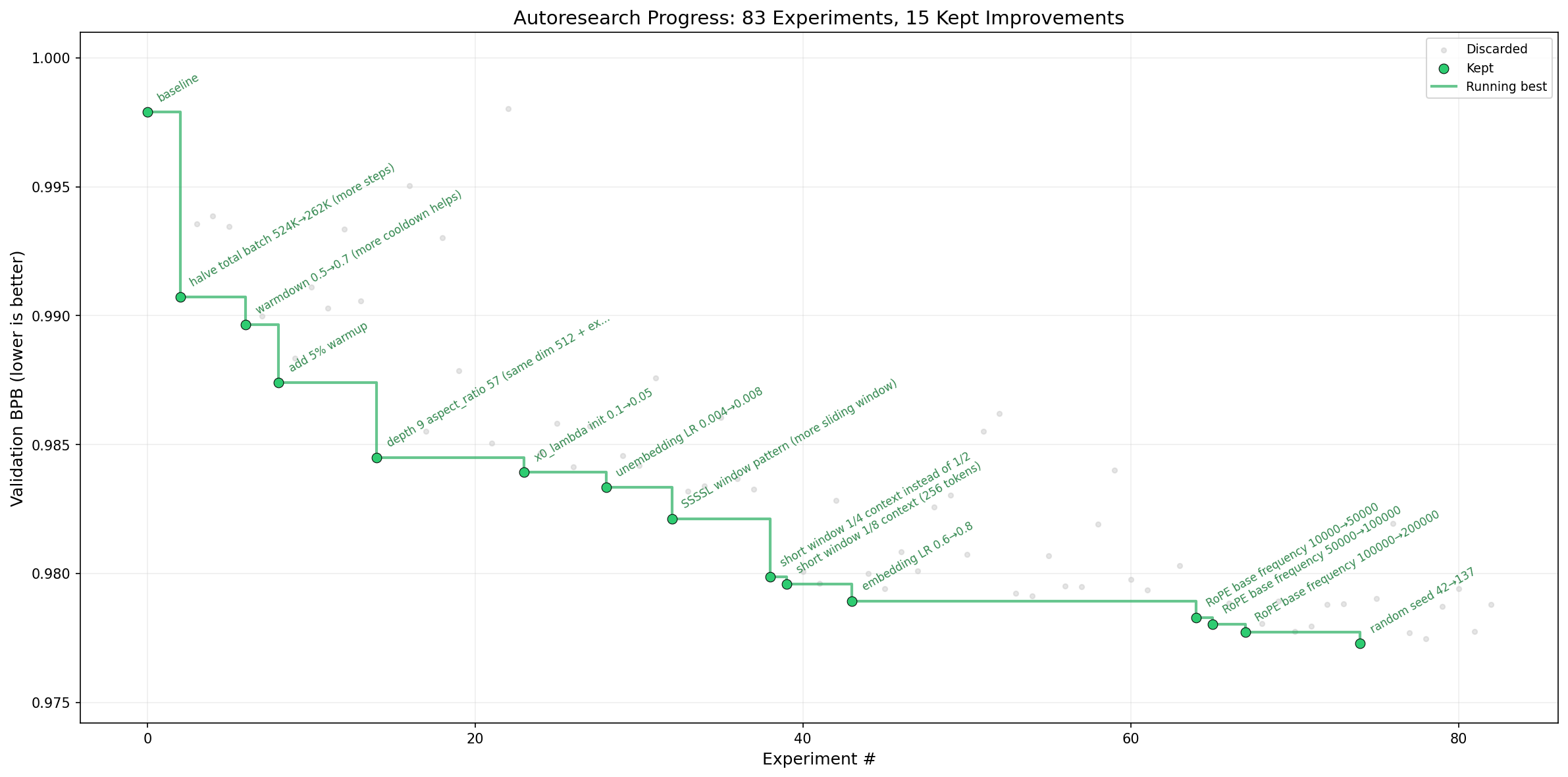
Andrej Karpathy released Autoresearch on GitHub Friday -- an open-source project that lets an AI agent autonomously run machine learning research experiments overnight on a single GPU. The setup is deliberately minimal: the agent is given a small language model training codebase (based on Karpathy's 'nanochat' project), a fixed 5-minute time budget per experiment, and a plain-text markdown file describing the research goal. The agent writes modifications to the training script, runs the experiment, measures whether validation loss improved, keeps the change if it did, discards it if not, and repeats -- logging every decision. By morning, the researcher has a log of autonomous experiments and potentially a better model. The project is designed as a proof of concept for applying AI to the research iteration loop itself, not just to writing code. Karpathy noted with characteristic irony that the README describes a hypothetical distant future where the project's codebase is now 'a self-modifying binary' in its 10,205th generation, 'grown beyond human comprehension.'
Andrej Karpathy was a founding member of OpenAI and later director of AI at Tesla. After leaving Tesla in 2022, he has released a series of minimalist open-source projects -- nanoGPT, nanochat -- that distill core ideas in deep learning into small, readable codebases used widely for teaching and research. Autoresearch extends this approach into autonomous research: rather than a human iterating on training code manually, the AI agent does it. 'val_bpb' (validation bits per byte): the metric the agent optimizes, measuring how well the model predicts held-out text.
A new approach to cancer radiation treatment called FLASH radiotherapy is advancing from physics labs -- including CERN -- toward early clinical trials, with the potential to transform oncology. Standard radiation therapy delivers low doses of X-rays over dozens of sessions spanning weeks; FLASH instead delivers a single dose hundreds of times larger, compressed into less than one-tenth of a second. Study after study in animal models finds that this ultrafast approach kills tumors as effectively as conventional radiation while causing far less damage to surrounding healthy tissue. The mechanism appears to involve oxygen depletion in normal cells during the extremely brief pulse, which protects them from radiation damage in a way that slower delivery does not. The technique was first discovered in the 1990s at Paris's Institut Curie, when researchers noticed that mouse lungs exposed to ultrafast blasts developed none of the expected scarring. CERN -- normally a particle physics facility -- is now collaborating with French company Theryq to develop compact hospital-scale accelerators for FLASH delivery.
CERN (European Organization for Nuclear Research), best known for the Large Hadron Collider and the discovery of the Higgs boson, has been redirecting some of its accelerator expertise toward medical applications. Conventional radiation therapy relies on physics discovered by Wilhelm Rontgen in 1895 and remains a standard treatment for more than half of all cancer patients globally. The key trade-off FLASH appears to break is the longstanding assumption that you cannot kill a tumor without also damaging the surrounding healthy tissue to a meaningful degree.
New State Department data on international student visa issuances for 2025 shows a 36 percent year-over-year decline -- steeper than existing enrollment counts had indicated and likely the largest single-year drop in modern history. The Chronicle of Higher Education reports that the fall reflects several converging forces: softening global interest in US higher education amid political uncertainty, visa processing backlogs, aggressive Trump administration rhetoric toward foreign nationals, and intensifying competition from universities in the UK, Canada, and Australia. International students contribute roughly $40 billion annually to the US economy, and represent a disproportionate share of graduate enrollment in STEM fields -- particularly in PhD programs in engineering, computer science, and the physical sciences. Several research universities have already begun graduate admissions freezes and faculty hiring pauses in anticipation of the shortfall. Visa issuance data is a forward-looking indicator: a 36% visa drop typically produces a comparable enrollment decline one academic year later.
US universities have become heavily financially dependent on international students over the past two decades, particularly as federal and state funding per student has declined. International students typically pay full non-resident tuition, making them a key revenue source for graduate programs. In STEM PhD programs -- which are usually tuition-free for domestic students -- international students often make up 50-70% of enrollment. A large sustained drop in international enrollment would put significant financial pressure on major research universities.
A 700-gram fossil recovered from Patagonia, Argentina, is overturning the leading explanation for how a lineage of small dinosaurs -- the alvarezsaurids -- evolved their diminutive size. For decades, paleontologists assumed these animals shrank as a direct adaptation to eating social insects like ants and termites, with miniaturization and dietary specialization evolving together in a tidy package. But the new species, Alnashetri cerropoliciensis, is one of the smallest alvarezsaurids ever found and yet predates the specialized ant-eating anatomy: it had long limbs, generalist teeth, and the build of a fast pursuit predator of small animals, not a termite miner. It also occupies an early-branching position in the alvarezsaurid family tree -- meaning it was small before the group developed its characteristic stubby, single-clawed forelimbs. The find by paleontologists at the University of Minnesota and Argentine collaborators suggests miniaturization in this lineage came first, with dietary specialization following much later.
Alvarezsaurids were a group of non-avian theropod dinosaurs known from Late Cretaceous deposits in Asia and South America, weighing from a few hundred grams to a few kilograms. They are notable for extremely short, robust forelimbs -- often with a single oversized thumb claw built for digging into insect mounds -- and small, peg-like teeth adapted for eating insects. Some species like Shuvuuia deserti from Mongolia were fully nocturnal, with hearing adapted like an owl's. The new Patagonian fossil is 90 million years old and was found in the Candeleros Formation in Argentina's Rio Negro Province.
US headline economic numbers -- GDP growth around 2.5%, stable prime-age employment, inflation near 2.5% -- look unremarkably healthy. But two things underneath are genuinely strange: labor productivity is growing at 2.5-3% per year, among the best rates since World War II, while job creation has essentially stalled out. The obvious conclusion -- that AI is replacing workers -- turns out, on inspection, to be mostly wrong. Economist Noah Smith finds that the biggest productivity swing has been in manufacturing, not white-collar work, and the driver is not knowledge workers using Claude Code or ChatGPT. Instead, the data points to a massive wave of data center construction: data centers and computing equipment are being counted as high-value manufactured capital goods in the national accounts, and machines are running more hours per day. Smith's conclusion is that the economy's strange numbers mostly reflect an AI infrastructure boom, not an AI use boom -- and that the productivity gains are partly a statistical artifact of how we measure data center output rather than a genuine sign that AI is transforming the way most people work.
Noah Smith (Noahpinion) is an economist and journalist whose newsletter focuses on data-driven explanations of why economies behave unexpectedly. His pieces typically feature FRED charts and specific empirical claims rather than speculation. 'Prime-age employment rate' measures what share of adults aged 25-54 are employed -- generally the cleanest single indicator of the labor market because it is not distorted by retirement or school enrollment patterns. 'Labor productivity': output per hour worked across the economy, a standard metric for how efficiently labor is being used.
Autonomous weapon systems and AI-assisted targeting have featured prominently in the Iran conflict's opening weeks, making this National Review essay unusually timely. The author argues that while AI can legitimately improve military performance in surveillance, logistics, and intelligence fusion, delegating lethal targeting decisions to autonomous systems violates both the laws of war and basic moral logic. No current AI system can reliably distinguish combatants from civilians in complex urban environments, and the speed advantage of autonomous targeting does not justify the risk of systematic misidentification. The piece draws on published studies of AI targeting accuracy to argue that human judgment must remain in the decision loop for any strike -- not as a formality, but as a substantive check. The argument is explicitly not anti-AI in warfare broadly, but draws a principled line at the decision to kill a specific person.
International humanitarian law -- also called the laws of war or the Geneva Conventions framework -- requires that lethal force be directed only at combatants and military objectives, that expected civilian harm be proportionate to military advantage, and that attacks be preceded by feasible precautions. The legality and ethics of autonomous weapons systems have been debated in UN forums since 2013, but no binding international treaty has been agreed. The Iran conflict has featured reported use of AI-assisted targeting by both US-Israeli forces and Iranian air defenses.