Russia hit Ukraine with 948 drones over a 24-hour span, the heaviest such barrage of the war and one that pushed deep into the country's western cities rather than staying near the front. BBC and AP report that more than 400 drones came in during a daytime wave on Tuesday alone, with strikes injuring at least 22 people in Lviv and killing two in Ivano-Frankivsk. Local officials said a 16th-century Bernardine monastery, residential buildings and a maternity hospital were damaged. The immediate military message is that Russia can now sustain attacks at a scale that forces Ukraine to defend far more of its map at once. The political message is similar: western Ukraine had been relatively less exposed than eastern regions, so a record barrage there is a way of showing that distance from the battlefield no longer guarantees much safety.
Russia has steadily scaled up drone saturation attacks, but western cities such as Lviv and Ivano-Frankivsk had still seen fewer and lighter strikes than front-line regions. A barrage of this size forces Ukraine to spread air defenses across far more territory at once.
The Supreme Court is back in the birthright-citizenship fight, with arguments on April 1 over Donald Trump's order denying automatic citizenship to some children born in the United States to undocumented immigrants and temporary visitors. The justices sidestepped the core constitutional question last year and instead limited lower courts' nationwide injunctions, but the administration has now returned asking the Court to bless a much narrower reading of the Fourteenth Amendment's citizenship clause. Challengers argue that the text, the 1898 Wong Kim Ark precedent, and more than a century of practice all cut the other way. What makes the case bigger than ordinary immigration litigation is the legal theory underneath it: the government is effectively asking whether a president can redefine one of the country's most settled constitutional guarantees through executive action. If the Court accepts that premise, the impact would reach well beyond this one order.
The administration's theory turns on the Fourteenth Amendment phrase "subject to the jurisdiction thereof." Opponents say the Supreme Court settled the issue in United States v. Wong Kim Ark in 1898 and that only children of diplomats or occupying enemies fall outside birthright citizenship.
Israel said it will impose a new security zone in southern Lebanon, signaling that the current war with Hezbollah is hardening into a territorial arrangement rather than a short retaliatory campaign. Defence Minister Israel Katz said Israeli forces had destroyed five bridges over the Litani River and would keep displaced Lebanese residents from returning to parts of the south until northern Israel is considered safe. The line matters because the Litani sits roughly 30 kilometers from the border, much deeper than a narrow frontier strip. Israeli officials say the aim is to block Hezbollah fighters and weapons routes after months of rocket fire and the latest escalation tied to the Iran war. For Lebanon, the announcement reads like the threat of a quasi-reoccupation: the health ministry says more than 1,000 people have been killed in the current fighting and over a million displaced, and now entire communities are being told their return date depends on Israel's security judgment.
Israel and Hezbollah fought a major cross-border war through 2024 before a ceasefire. The latest escalation followed renewed rocket fire from Hezbollah and Israeli strikes linked to the broader Iran conflict.
Trump has ordered federal regulators to reopen some of the post-2008 mortgage rules that reshaped home lending after the financial crisis, arguing that community banks have been pushed out of the market by compliance costs. The White House order tells the Consumer Financial Protection Bureau and other agencies to review ability-to-repay and qualified-mortgage rules for banks under $100 billion in assets, consider a broader safe harbor for loans kept on banks' own books, and loosen disclosure and closing requirements that the administration says delay lending. The policy is being sold as an affordability and competition measure for rural, first-time and lower-income borrowers. The risk is that this is exactly the part of the system where the lessons of 2008 still matter most: those rules were designed to stop lenders from making mortgages people could not realistically carry and then treating the paperwork as someone else's problem. Whether the changes stay technical or become a real rollback will depend on how far regulators go.
The order is titled "Promoting Access to Mortgage Credit." It focuses on community banks and smaller banks, especially rules around ability to repay, qualified mortgages, and TILA-RESPA disclosures that were tightened after the Great Recession.
Anthropic has turned Claude Code from a terminal assistant into something closer to a permissioned desktop agent. The new research-preview features let Claude scroll, click, and explore a computer directly when connectors to outside apps are unavailable, and those sessions can also be managed remotely through Anthropic's Dispatch tool. That matters because it changes the product from "write the command for me" to "finish the task for me," which is where the commercial race around personal AI agents is now headed. Ars Technica reports that Anthropic is trying to fence the feature in with default bans on high-risk categories such as trading and cryptocurrency, plus training intended to avoid risky file changes or money movement. But the company is also unusually explicit that the safeguards are not absolute and that Claude can see whatever is on the screen. In other words, the product is arriving at the same moment the company is warning users not to trust it too much.
Anthropic previously emphasized terminal access and app connectors. Direct computer use moves it into the same emerging category as other agents that operate browsers and desktops rather than waiting for structured API access.
Epic Games is laying off more than 1,000 workers, a reminder that even one of the industry's biggest live-service hits no longer guarantees corporate stability. CEO Tim Sweeney said Fortnite engagement has been falling since last year and that the cuts, together with more than $500 million in savings from contracting, marketing, and open positions, are meant to put the company on firmer ground. He also pointed to wider pressures on the games business: heavier competition, reduced consumer spending, and the difficulty of keeping live-service titles feeling fresh season after season. Epic is still huge, which is what makes the announcement notable. This is not a small studio running out of cash; it is the company behind Fortnite, the Epic Games Store, and years of legal and platform fights that helped define the industry's current business model. Even so, it is trimming sharply and winding down several Fortnite side modes to focus on the core product.
Epic cut more than 800 roles in 2023. The latest move comes as the live-service model looks less like a one-way growth engine and more like a fight to hold player attention over years.
Australia and the European Union have finally closed a broad trade and security deal after years of stop-start negotiations, giving both sides a hedge against a world where U.S. policy is volatile and China's economic pull is harder to navigate cleanly. BBC and AP report that the package, signed in Canberra and valued at roughly A$10 billion, will remove almost all tariffs while expanding cooperation on defence and critical minerals. That combination tells you what the agreement is really about: not just selling more wine, beef, or cars, but building supply chains and strategic ties that look sturdier in a more fragmented world. There are still losers inside the compromise. European carmakers welcomed the accord, but farmers on both sides objected to the quota terms for Australian beef and lamb. Even so, the larger significance is that Brussels is still rapidly diversifying its trade relationships, and Australia is willing to lock in deeper economic alignment with Europe rather than wait for the old geopolitical center of gravity to return.
Brussels has been accelerating trade deals as Trump-era volatility and China-related tensions push countries to diversify. Critical minerals matter because Europe wants more secure supply for batteries, energy systems, and defense manufacturing.
via Scientific American, The Astrophysical Journal Letters
Astronomers have caught only the second confirmed solar system ever seen in the act of forming, which is the kind of result that can change how planet formation gets studied rather than just add another exoplanet to the catalog. Writing in The Astrophysical Journal Letters, the team reports that the star WISPIT 2, about 437 light-years away, appears to host at least two newborn gas giants still embedded in its protoplanetary disk, with hints of a third world farther out. The first such system, PDS 70, was confirmed in 2018; until now, it was hard to know whether it was unusual or simply the first clear case. That is why researchers are excited by a sample size of two. Systems like this let astronomers watch the sculpting of rings and gaps in real time and test theories about how planets grow from dust and gas, instead of reconstructing the process long after the evidence has cooled.
WISPIT 2 was observed with the European Southern Observatory's Very Large Telescope in Chile. Astronomers hope follow-up with the Extremely Large Telescope will confirm whether a third infant planet is also forming there.
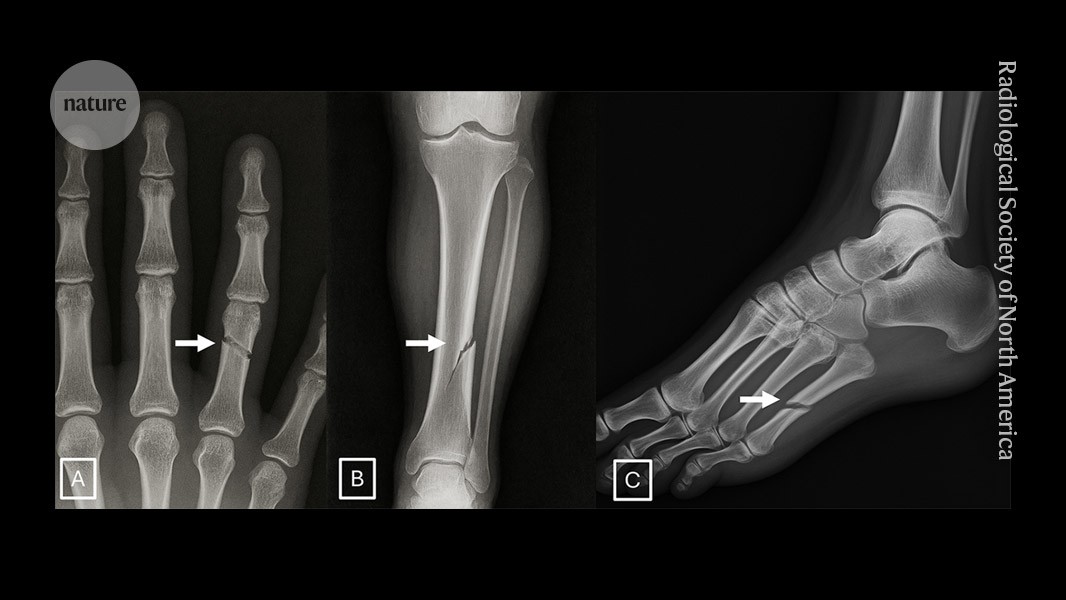
AI-generated medical X-rays are now realistic enough to fool most radiologists on first contact, according to a Radiology study highlighted by Nature, and that is a problem not just for diagnosis but for the entire evidence chain around medical images. In the experiment, 17 radiologists from 12 research centers were shown a mixed data set of real and synthetic scans without being told the trick. Only 41 percent raised concerns that fake images might have slipped in. Even after participants were told some images were AI-made, they identified real versus synthetic scans correctly about 75 percent of the time on average, and large language models also struggled. The immediate risk is that synthetic images could seep into training sets for medical AI, papers, insurance disputes, or court cases and quietly distort systems that assume scans are trustworthy records of the body. The study also found that targeted training helps, which means the defense is possible but not automatic.
The paper appears as hospitals and researchers increasingly use synthetic data to train models or augment small medical data sets. That makes realism a double-edged trait: useful for development, but dangerous if provenance is lost.