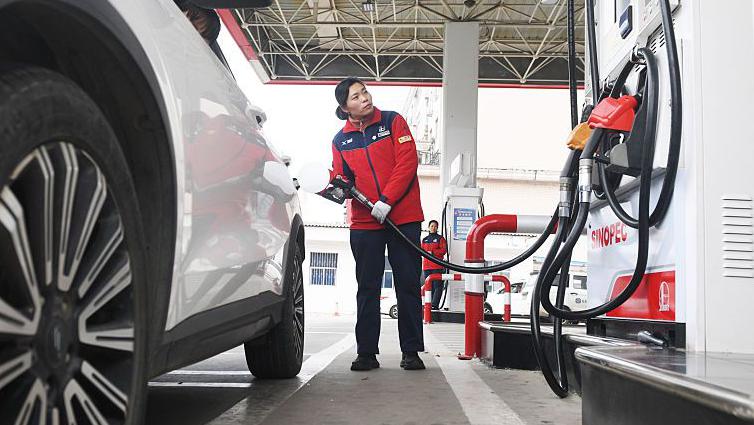
China cut back what would have been its biggest fuel-price increase of the year after the Iran war sent oil costs surging across Asia, a sign that the Strait of Hormuz shock is now hitting ordinary consumers rather than staying confined to markets. Beijing had been set to raise gasoline and diesel prices by 2,205 yuan and 2,120 yuan per tonne, but the National Development and Reform Commission roughly halved those increases before they took effect on Tuesday. Even with the adjustment, BBC reporting says petrol prices in China are up about 20 percent since the conflict began. Long queues formed at some stations over the weekend, and reports said refiners were told to pause fuel exports to keep more supply at home. For a country with vast oil reserves, that is the important signal: China is not out of fuel, but it is already managing scarcity politics.
China reviews petrol and diesel prices on a ten-day cycle. The latest move followed the effective closure of the Strait of Hormuz, a major oil-shipping chokepoint, and a sharp jump in the price of Middle Eastern crude.
The Federal Communications Commission has effectively barred future consumer routers made outside the United States from being imported or sold unless manufacturers win special conditional approval and show a path toward domestic production. Existing devices can still be used, so this is not a forced replacement order. The significance is in the scope: because most home routers are built in Taiwan or China, the rule reaches far beyond one suspect brand. The FCC said foreign-made routers belong on its Covered List because attackers exploited router weaknesses in the Volt, Flax and Salt Typhoon campaigns against U.S. infrastructure. TP-Link, a top seller in the American market, has been a particular political focus, but the new policy is category-wide. The practical effect is that Washington has moved routers from being treated as cheap household gadgets to being treated as national-security equipment.
The FCC's Covered List was originally built around telecom equipment tied to foreign adversaries. The router expansion goes further by treating a common consumer device as part of the same supply-chain and espionage problem.
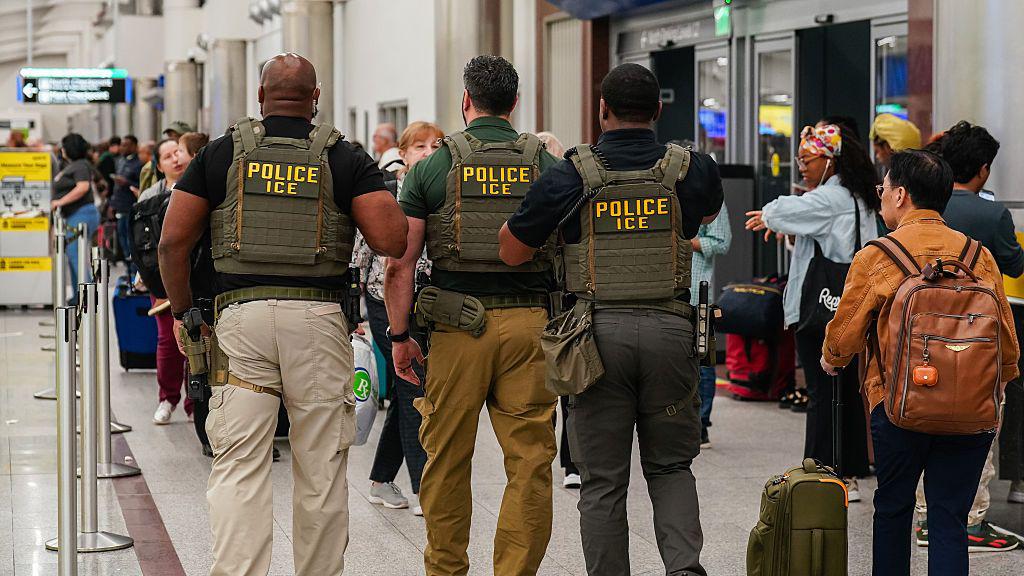
Armed ICE officers appeared at major U.S. airports on Monday after President Donald Trump ordered them in to help amid a prolonged Homeland Security funding lapse that has left TSA staffing badly depleted. AP and BBC reporters saw immigration agents at airports including JFK, Newark, Atlanta, Houston and New Orleans as security lines stretched for hours and some passengers were told to arrive three or four hours early. The administration says ICE and Homeland Security Investigations officers are only handling crowd control and other non-specialized tasks so TSA staff can focus on screening. But the visual and political effect is larger than that. Immigration officers are a normal presence at international arrivals, not at the domestic-security front line, and their appearance at checkpoints makes the shutdown feel less like a budget dispute and more like a visible change in how ordinary travel is policed.
The partial DHS shutdown began on February 14 after Congress failed to renew funding. Thousands of TSA employees have been working without pay, and airport operators warned Monday that the disruptions were growing and could become long-lasting.
Hong Kong's government has quietly widened the reach of its national security regime again, giving police the power to demand phone or computer passwords from people suspected of violating the law. Refusal can now bring up to a year in jail and a HK$100,000 fine, while giving false or misleading information can bring up to three years. The amendments also let customs officials seize items they believe carry seditious intent. On paper, password demands are not unusual in criminal investigations. What makes this different is the law they now serve. Hong Kong's national security framework covers broad and loosely defined offenses including secession, subversion and collusion with foreign forces, and it has already been used against activists, media figures and relatives of people in exile. The new rules therefore expand not only investigative power but also the state's leverage over the private digital lives of anyone it targets.
Beijing imposed the national security law on Hong Kong in 2020 after the 2019 protest wave. Officials call it necessary for stability; critics argue it has steadily turned dissent, journalism and opposition politics into security offenses.
Epoch AI says one of its FrontierMath research problems has been solved after Kevin Barreto and Liam Price elicited a proof from GPT-5.4 Pro for a Ramsey-style hypergraph question that had still been listed as open. The benchmark page now marks the problem as solved and says contributor Will Brian, a mathematician at UNC Charlotte, confirmed the solution and plans to write it up for publication. That does not make this a finished historical verdict; the result still needs the normal life of formal write-up, peer scrutiny and follow-on checking. But it is more interesting than the usual headline about a model doing well on contest math. FrontierMath was built specifically to resist easy benchmark saturation with problems intended to feel close to live research. If the confirmation holds, this would be one of the clearest cases yet of a frontier model contributing a genuinely new mathematical result rather than just reproducing known techniques quickly.
FrontierMath is a benchmark designed to test whether advanced models can handle research-level mathematics rather than standard Olympiad-style exercises. The solved problem concerns extremal constructions in hypergraph Ramsey theory.
[China Watch] A new U.S. congressional advisory report argues that China's AI advantage may come less from matching OpenAI or Google at the absolute frontier than from combining cheap open models with the country's manufacturing base. The report, from the U.S.-China Economic and Security Review Commission, says those two strengths reinforce each other: open models spread quickly through factories, logistics systems and robotics, which then generate real-world data that helps improve the next generation of models. In this telling, the strategic risk for the United States is not simply that Chinese labs catch up on benchmarks. It is that China captures users, standards and industrial deployment at scale while American firms stay focused on closed high-end systems. The report still says U.S. models retain a narrow lead in raw capability, and even sympathetic analysts quoted in the piece note open source has unresolved business-model problems. But the warning is clear: compute leadership alone may not decide the AI race.
China's AI strategy has leaned heavily on lower-cost open models and industrial adoption, while U.S. leaders have emphasized frontier capability and tighter control. The report frames those as rival paths to influence, not just rival research styles.
An MIT-led team is arguing that the right medical AI should behave less like an oracle and more like a cautious junior colleague. Their new framework asks diagnostic systems to score their own certainty, surface when a case is too ambiguous, and prompt clinicians to gather more information instead of confidently steering them toward a possibly wrong answer. That matters because previous studies have found that ICU doctors often defer to AI systems they regard as authoritative even when their own intuition points elsewhere. The paper's underlying point is not that doctors need more AI advice; it is that they need AI that knows when not to act certain. The researchers describe this as building humility and curiosity into the model rather than treating uncertainty as a bug to hide. If that design philosophy spreads, it would push high-stakes AI away from the chatbot habit of sounding decisive and toward something more clinically usable.
The study appears in BMJ Health and Care Informatics and comes from an international consortium led through MIT Critical Data. Its core idea is that uncertainty should be made visible to human users instead of smoothed away.
Slovenia has become the first European Union member state to impose fuel rationing during the current Gulf energy shock, capping private motorists at 50 litres a day and businesses or farmers at 200. The immediate cause is not empty national reserves but a local market distortion: Slovenia keeps pump prices regulated below those in neighboring Austria, so the surge in regional fuel costs triggered a wave of cross-border "fuel tourism" that left some stations crowded or dry. Prime Minister Robert Golob insists warehouses are full and there is no national shortage, but the government is still making stations enforce rationing and is encouraging even tighter limits for foreign drivers. That is why the story matters. The oil crisis is no longer just visible in charts of Brent crude. It is showing up in queues, border arbitrage and emergency retail controls inside an EU member state that normally looks far from the center of Middle East conflict.
The pricing gap with Austria made Slovenia attractive for drivers crossing the border just to refuel. Once regional supply stress intensified, that price-control advantage turned into a practical shortage problem at the pump.
[China Watch] Asia-Pacific private equity is getting more defensive. A new Bain report says fundraising for the region fell to $58 billion in 2025, the lowest level in twelve years, while investors shifted money away from the old technology-media-telecom default and toward sectors with steadier cash flow such as advanced manufacturing, healthcare, energy and services. That is not just a mood change. It reflects a harsher environment in which limited partners are choosier, exits are harder, and funds need to show they can actually return money rather than simply promise growth. Bain says the technology sector is still the region's biggest destination for deal value, but its share has dropped to a ten-year low. Greater China, meanwhile, retook the lead as Asia's largest private-equity exit market as IPO and open-market exits recovered. In plain English: capital is still there, but it now wants sturdier stories and faster proof.
Private-equity funds need profitable exits such as IPOs or share sales to return cash to their investors. When those exits slow down, fundraising usually tightens and firms gravitate toward businesses that look easier to monetize.
MIT researchers have built a clearer picture of what climate change may do to hydroxyl radicals, the atmospheric molecules that destroy most of the methane humans release. The headline is neither doom nor easy comfort. A warmer planet should hold more water vapor, which tends to increase hydroxyl levels and improve the atmosphere's ability to break down methane. But warming also drives more natural emissions from plants and trees, and those chemicals pull hydroxyl levels back down. In the team's model, a world that warms by 2 degrees Celsius ends up with only about a 3 percent net increase in hydroxyl radicals after those forces offset each other. That sounds technical, but it matters because methane is a powerful greenhouse gas and hydroxyl chemistry helps determine how long it lingers. The study suggests the atmosphere's self-cleaning system may prove more resilient than feared, though only modestly and not enough to rescue us from the larger emissions problem.
About 90 percent of the methane removed from the atmosphere disappears through reactions with hydroxyl radicals, often described as the atmosphere's detergent. Small changes in that chemistry can therefore affect both warming and air pollution.