IBM became the first company to settle under Trump's Civil Rights Fraud Initiative, agreeing to pay $17 million over claims that its old DEI programs for federal contractors illegally used race and sex in hiring, interviews, bonuses, mentoring, and training. The Justice Department said IBM falsely certified compliance with anti-discrimination rules in federal contracts; IBM denied wrongdoing and said many of the challenged practices had already been ended or revised. The case matters beyond IBM because the administration is treating DEI disputes as False Claims Act cases, which raises the financial risk for any contractor that still has demographic targets or restricted leadership programs on the books. A culture-war campaign has now turned into an enforcement model: instead of just denouncing DEI, Washington is trying to make companies pay for having run it.
The Civil Rights Fraud Initiative was launched in May 2025 to argue that federal contractors can trigger False Claims Act liability if they certify compliance with anti-discrimination rules while running race- or sex-based programs. That gives DEI fights a direct link to contract money.
Italy's Giorgia Meloni publicly broke with Donald Trump after he called Pope Leo XIV "weak on crime" and bad on foreign policy, a rare split between two leaders who have otherwise worked hard to stay aligned. Meloni said a pope is supposed to preach peace and condemn war, and Matteo Salvini, her coalition partner, also said attacking the pontiff made no sense. Leo, flying to Algeria for his first Africa tour as pope, said he had "no fear" of Trump and would keep speaking loudly about the Gospel. The clash has grown beyond an insult. It has turned Leo's criticism of the Iran war into a test of whether Europe's nationalist right will follow Trump even when he is attacking the head of the Catholic Church.
Leo succeeded Pope Francis this year and has kept pressing for an end to the Iran war. Meloni has usually tried to preserve a working relationship with Trump, so her decision to rebuke him in public stood out immediately in Italian politics.
Texas Tech's system told campuses to phase out every degree, minor, and certificate "centered on" sexual orientation or gender identity, pushing Texas' campaign against DEI further into the curriculum itself. Chancellor Brandon Creighton ordered provosts to classify courses by how directly they deal with those subjects and to cancel programs that put them at the center, while allowing only incidental references or instruction needed for licenses, medicine, or chromosomal variation. That goes past symbolic office closures and into what universities can formally teach. For students and faculty, the message is blunt: gender and sexuality may still appear at the edges of other courses, but they can no longer anchor an academic program in the Texas Tech system.
Texas public universities have already been under pressure to close DEI offices and restructure related departments. The University of Texas recently moved to consolidate gender and ethnic studies, and Texas A&M shut down its women and gender studies department earlier this year.
Voters in Festus, Missouri, threw out all four city-council incumbents who were on the ballot days after the council approved a controversial data-center plan, turning a local development fight into a clean electoral rebuke. Local coverage said turnout was unusually high for a municipal race and that three of the defeated incumbents had backed the project. Opponents said the council pushed ahead without listening to residents, while supporters had framed the project as an economic opportunity. The election does not automatically kill the data-center proposal, but it does change the council that will have to live with the backlash. It's a sharp reminder that data centers now trigger the same kind of neighborhood politics as highways, landfills, or stadium deals when voters think the benefits and burdens were never honestly explained.
Festus approved the project in a 6-2 vote on March 30. The election result does not by itself reverse that decision, but it puts the backlash in the official record and hands future negotiations to a council that just watched incumbency fail all at once.
A 63-year-old man with HIV has gone into long-term remission after receiving a bone-marrow transplant from his brother, whose cells carried the rare CCR5 delta32 mutation that blocks the receptor most HIV strains use to enter immune cells. Researchers reported that donor cells took over not just the patient's blood but also bone marrow and gut tissue, and they found no detectable reservoir of HIV after he later stopped antiretroviral therapy. The case is the first reported remission achieved with a sibling donor rather than an unrelated matched donor, which matters because family matches are easier to find. It is not a treatment ordinary patients can pursue; bone-marrow transplants are dangerous and usually reserved for people who already need them for leukemia or another serious blood disorder. But it gives cure research another real-world proof that eliminating CCR5 can work.
A small number of earlier remissions, including the Berlin and London patients, also came after bone-marrow transplants from donors with the same mutation. The barrier is not proof of concept; it is that the procedure is too risky to use as a routine HIV treatment.
Beijing is trying to win the AI race on a second front: not just model performance, but rule-writing. At a new AI governance conference in Hong Kong, Alibaba policy executive Fu Hongyu argued that governments and companies are operating in "common ignorance" because the technology is moving faster than anyone fully understands, and said China has moved to the front of the global debate on guardrails. The pitch is strategically shrewd. Chinese firms still trail the strongest American models by months, not years, so governance is a place where Beijing can shape norms without first leading on frontier capability. The line China keeps repeating is balance: keep building, keep deploying, but set rules early enough that safety arguments do not become a disguised American monopoly advantage.
China started publishing nationwide generative-AI rules in 2023 and has kept arguing that safety controls should be built alongside deployment, not after it. The Hong Kong meeting gave Chinese companies a stage to present that position as global leadership rather than caution.
Mathematics has passed the stage where AI is just a flashy olympiad solver. Quanta reports that after models solved five of six International Mathematical Olympiad problems last summer, working mathematicians who had dismissed them as unreliable started using them on real research questions and, in some cases, getting publishable results. The interesting part is not a single earthshaking theorem; it is the change in workflow. Researchers are using models to guess lemmas, test examples, surface patterns in huge symbolic spaces, and keep exploratory conversations going when a human would normally run out of fresh angles. Terence Tao describes the pairing as one person with a shovel and one with a pickax. That is a good image for where things stand: AI is not replacing proof, but it is changing how mathematicians dig toward one.
The trust problem has not gone away. Mathematicians still have to verify every claimed step, and many researchers treat models more like conjecture machines than proof engines. Even so, that is enough to change the exploratory part of research.
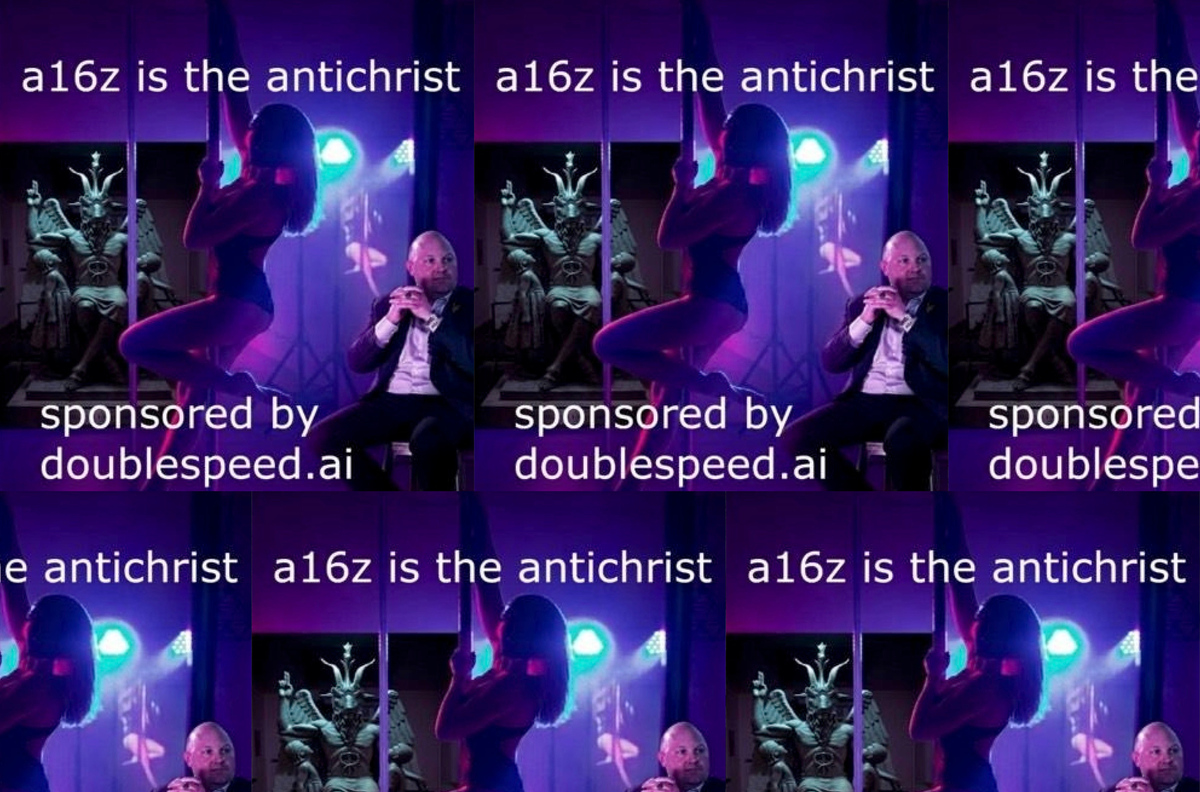
A hacker broke into Doublespeed, an Andreessen Horowitz-backed startup that runs phone farms to manufacture AI influencers and post at scale across social platforms, then tried to use the company's own system to publish memes calling a16z the "antichrist." 404 Media says the intruder exfiltrated tens of megabytes of data, claimed access to hundreds of phones and more than 500 postable accounts, and queued the meme inside customer dashboards before it apparently failed to go live. The story is funny on the surface and ugly underneath. Doublespeed's business is already a bet that social feeds can be industrially flooded with synthetic personalities; the breach shows how quickly that same machinery can be turned against the people funding it. When influence is automated, sabotage becomes automatable too.
404 Media says this is at least the second compromise involving Doublespeed. The company sells industrialized posting: banks of phones, AI-generated personas, and automated social activity for customers who want reach without real human creators.
WebinarTV, a site that has been scraping Zoom webinars without permission, also archived meetings that participants reasonably assumed were private: anonymous addiction-recovery sessions, caregiver support groups, chronic-illness discussions, and even a nudist meeting. 404 Media found examples that had been downloaded and published before organizers granted any permission, contradicting the company's claim that it asks first. For some groups, the harm is obvious. An anonymous meeting only works if people believe they can speak without being recorded, indexed, and replayed on a public website. The story is a reminder that "webinar" is not the same thing as "public event," and that platforms built for easy broadcasting keep blurring that boundary unless organizers know exactly which settings, links, and third-party tools are in the loop.
404 Media first reported on WebinarTV in March after a teacher found that a meeting for educators worried about ICE raids had been reposted. The company says it hosts more than 200,000 scraped Zoom webinars, which makes every ambiguous privacy setting matter more.
The AI boom in science is real; the autonomous-lab hype is still ahead of the evidence. Nature's write-up of Stanford's AI Index says papers mentioning AI in the natural sciences grew nearly 30-fold from 2010 to 2025, and new domain-specific foundation models are spreading fast. But the same report says today's agents still stumble on long, multistep scientific workflows, with the best systems scoring only about half as well as human researchers on complex benchmark tasks. That gap matters because many of the loudest claims about "AI scientists" assume exactly the kind of chained planning, tool use, error recovery, and judgment that current agents still handle badly. Researchers are clearly adopting AI. The case for handing over an entire research pipeline remains much weaker.
The same report says roughly 6% to 9% of papers in natural-science fields now mention AI. That is large enough to show mainstream adoption, but it is not the same as saying labs can replace skilled researchers with autonomous agents.