The Trump administration brokered a 10-day ceasefire between Israel and Lebanon, set to begin Thursday at 5 p.m. Eastern. Trump announced the truce after phone calls with Israeli Prime Minister Netanyahu and Lebanese President Joseph Aoun. The deal followed the first direct diplomatic talks between the two countries in over four decades, held in Washington earlier this week. Israel and Hezbollah have been fighting since 2025 in a conflict entangled with the broader U.S.-Iran war that began in March 2026. Iran had insisted any American-brokered ceasefire must cover Lebanon, a demand Washington previously rejected. This agreement may break that deadlock. Trump invited both leaders to the White House for further negotiations, tasking Vice President Vance, Secretary of State Rubio, and the Chairman of the Joint Chiefs with pursuing a lasting peace. Hezbollah has not confirmed its acceptance.
Israel and Lebanon have had no formal peace agreement since 1983. The current fighting grew out of the U.S.-Iran war that erupted in March 2026, with Iran demanding any ceasefire extend to its Lebanese ally Hezbollah. Washington's refusal had stalled diplomacy until now.
Russia struck Ukraine overnight Thursday with nearly 700 drones and dozens of ballistic and cruise missiles in the deadliest aerial assault of 2026. At least 17 people died and over 100 were wounded across three cities. Kyiv took its first strikes in over a month, killing four people including a 12-year-old and injuring 48. Odesa suffered the heaviest toll with nine dead. Ukrainian air defenses intercepted 667 of 703 incoming projectiles, most of them Iranian-designed Shahed drones. The barrage came days after a 32-hour Orthodox Easter truce collapsed on April 13 amid mutual accusations of violations. President Zelensky warned that air defense munitions are running critically low. Global demand for Patriot interceptors has surged since the U.S.-Iran war began in March, diverting supplies away from Ukraine. Peace talks remain stalled as Washington's attention stays fixed on Iran.
A brief Orthodox Easter ceasefire on April 13-14 broke down almost immediately, with both sides accusing the other of violations. The U.S.-Iran war that started in March 2026 has strained global Patriot missile stocks, leaving Ukraine competing for limited interceptor supplies.
Anthropic released Claude Opus 4.7, its most capable publicly available model. The biggest upgrade is vision: the model now processes images up to 2,576 pixels on the long edge, more than triple the previous limit, letting it parse detailed screenshots and technical diagrams. Software engineering performance also jumped, with users reporting they can delegate their hardest coding tasks to it. A new xhigh effort setting gives users finer control over how deeply the model reasons before responding, trading speed for thoroughness. Other improvements include better literal instruction following and a file-based memory system that persists across sessions. The announcement drew 816 points and 635 comments on Hacker News. Anthropic also teased a "Mythos Preview" in associated coverage, hinting at a next-generation model in development. Opus 4.7 sits at the top of Anthropic's lineup, above the lighter Sonnet and Haiku tiers.
Anthropic's Opus tier is its most capable model family. Claude Opus 4.6 was the previous flagship. Anthropic and OpenAI have been locked in an intense benchmarking race on coding agent tasks through early 2026.
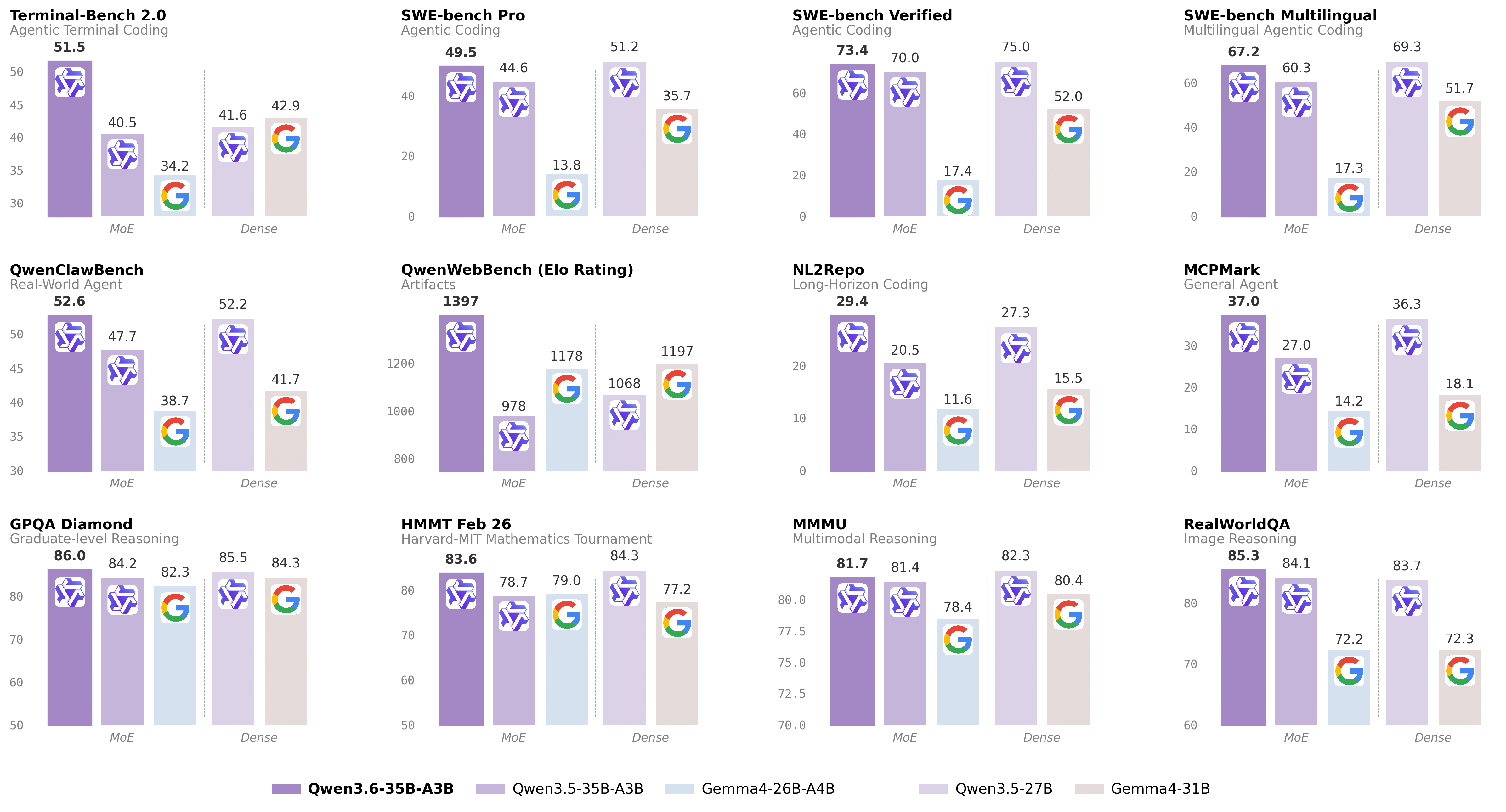
Alibaba's Qwen team open-sourced Qwen3.6-35B-A3B, a Mixture of Experts model with 35 billion total parameters but only 3 billion active per token. The architecture lets the model draw on a large learned capacity while keeping inference costs comparable to a much smaller model. Benchmark results are strong: 73.4 on SWE-bench Verified (a standard test of real-world software engineering), 92.7 on AIME 2026 math problems, and 92.8 on MMBench visual reasoning. The model handles text, images, and video, accepts 262,000 tokens of context natively (extensible to one million), and ships under Apache 2.0, meaning anyone can use it commercially for free. A feature called "thinking preservation" carries reasoning forward across conversation turns, which helps during iterative coding sessions. The release drew 531 Hacker News points and reinforces Alibaba's position as a leading open-weight competitor to closed-source labs.
The Qwen series from Alibaba's AI team has become one of the strongest open-source model families. Mixture of Experts architecture activates only a small fraction of total parameters per token, keeping compute costs low. SWE-bench measures AI performance on real GitHub engineering tasks.
OpenAI pushed a major update to Codex, its agentic coding assistant. The headline feature is computer use: Codex agents can now control desktop applications alongside the user, running programs without locking up the system. OpenAI built technology that lets agent and human operate in tandem on the same machine. The update also adds built-in image generation through gpt-image-1.5 for UI mockups and game assets, plus a memory system that recalls context from previous coding sessions and suggests follow-up actions. OpenAI shipped 111 new plugins connecting Codex to external tools, app integrations, and MCP server connections, along with a built-in browser with commenting for web development work. The Verge framed the release as a direct challenge to Anthropic's Claude Code. Codex is macOS-only for now. The announcement collected 115 Hacker News points.
Codex is OpenAI's dedicated agentic coding tool, competing head-to-head with Anthropic's Claude Code. Computer use, where AI controls desktop software alongside the human, became a key competitive feature in 2026.
A Cochrane systematic review pooling 17 clinical trials and 20,342 patients concluded that antiamyloid Alzheimer's drugs produce effects that are "absent or trivial," falling below the minimum clinically meaningful threshold. The review, led by Francesco Nonino at IRCCS Bologna in Italy, examined lecanemab (brand name Leqembi), donanemab, and several earlier failed drugs. All of them successfully clear amyloid plaques from the brain, confirming they work as designed biologically. The cognitive benefits for patients, though, did not reach clinical significance. The drugs also raise the risk of brain bleeding and swelling. Critics, including the Alzheimer's Society UK, argue the review dilutes the newer drugs' modest gains by lumping them with older failures. Lecanemab won FDA approval in 2023 as a vindication of the amyloid hypothesis, the dominant theory that Alzheimer's is driven by protein clumps in the brain. This review reopens that debate.
Lecanemab costs roughly $26,000 per year and requires regular infusions plus brain MRI monitoring. The FDA approved it in 2023 after decades of research guided by the amyloid hypothesis. Cochrane reviews pool data across multiple trials and are considered the highest tier of medical evidence.
A team led by David Reich and Ali Akbari at Harvard and the Broad Institute published the largest ancient genome study to date in Nature on April 15. They sequenced 10,016 new ancient West Eurasian genomes and combined them with existing data for a total of 15,836, then tracked how gene frequencies shifted over 10,000 years. The team identified 479 gene variants under strong directional selection, more than twenty times the roughly 21 variants previously known. Natural selection accelerated sharply after humans transitioned from hunting and gathering to farming. Over 60% of the selected variants map to modern health conditions: type 2 diabetes, autoimmune disorders like Crohn's disease, skin pigmentation, and neuropsychiatric conditions including schizophrenia. One variant linked to male pattern baldness became less common over 7,000 years. The results show humans are still actively adapting, evolutionarily, to the agricultural lifestyle that began 10 millennia ago.
Ancient DNA research extracts genetic material from skeletal remains at archaeological sites and sequences it to reconstruct population history. David Reich's lab at Harvard has built the world's largest ancient genome archive and pioneered many of the field's statistical methods.
ICE signed a $12.2 million contract with defense vendor Edge Ops LLC to deploy Project SAFE HAVEN, an AI surveillance system that maps immigrants' daily routines and social connections. The tool uses persistent passive data collection, harvesting location signals, Wi-Fi network connections, and mobile device data from phones and smartwatches to build behavioral profiles. It tracks habitual locations and travel routes, then lets agents query the system in plain language about specific individuals. An automated classifier labels targets as gang- or cartel-affiliated based on behavioral patterns alone, without requiring traditional evidence. The Lever, which broke the story, situates the contract within a broader trend: earlier reporting by 404 Media found Thomson Reuters' CLEAR database already feeds into ICE neighborhood-targeting operations. Civil liberties groups warn the system enables mass surveillance and discriminatory targeting through algorithmic profiling rather than probable cause.
Under the Trump administration's 2025-2026 immigration enforcement expansion, ICE has rapidly integrated commercial data brokers and AI tools into its operations. Previous investigations found commercial databases like Thomson Reuters' CLEAR system already embedded in ICE targeting workflows.
MIT Technology Review found that scammers are defeating bank facial recognition systems using virtual camera software sold openly on Telegram. The tools replace a phone's live camera feed with pre-recorded video or deepfakes, fooling liveness checks designed to confirm a real person is present. Two methods dominate: jailbreaking phones to enable virtual cameras, or injecting hooking frameworks into banking apps to redirect the camera feed. The tools are advertised across 22 Telegram channels in Chinese, Vietnamese, and English, marketed for "all kinds of KYC verification." Virtual camera attacks grew 25-fold between 2023 and 2024. Sophisticated fraud attempts nearly tripled over the same period. Operations run out of Cambodia and target banks in Vietnam, Thailand, Myanmar, the UK (Revolut), and Spain (BBVA). Crypto scams alone drained $17 billion in 2025. Banks had adopted video liveness checks after static photo selfies proved trivial to spoof; this attack renders that upgrade unreliable too.
Banks introduced video liveness checks after discovering that static selfie verification was easy to defeat with printed photos or screen displays. Virtual camera attacks evolved as the next countermeasure, making even video-based identity verification unreliable without additional safeguards.
Sweden is dismantling its decade-long digital-first classroom policy and returning to physical books, handwriting on paper, and pencils. The right-wing government, in power since 2022, invested 100 million euros in the transition. Preschools no longer need to use digital tools at all. Children under two will learn exclusively with analog materials. The government also plans a nationwide cellphone ban in schools. The reversal responds to declining PISA literacy scores: Sweden's reading results fell in both 2012 and 2022, and 24% of 15- and 16-year-olds now read below basic comprehension levels. Sweden was one of the most aggressive adopters of one-laptop-per-child programs in the 2000s, making this one of the most systematic national retreats from digital education yet. Tech companies and some educators pushed back, citing an EU projection that 90% of jobs will soon require digital skills. An OECD report raised similar concerns about the shift.
Sweden pioneered large-scale classroom digitization in the 2000s with one-laptop-per-child programs. Many countries followed suit through the 2010s. PISA scores provide the main international benchmark for comparing education systems across countries.